

The People’s Verdict: Why did Ecuador’s Constitutional Referendum Fail?
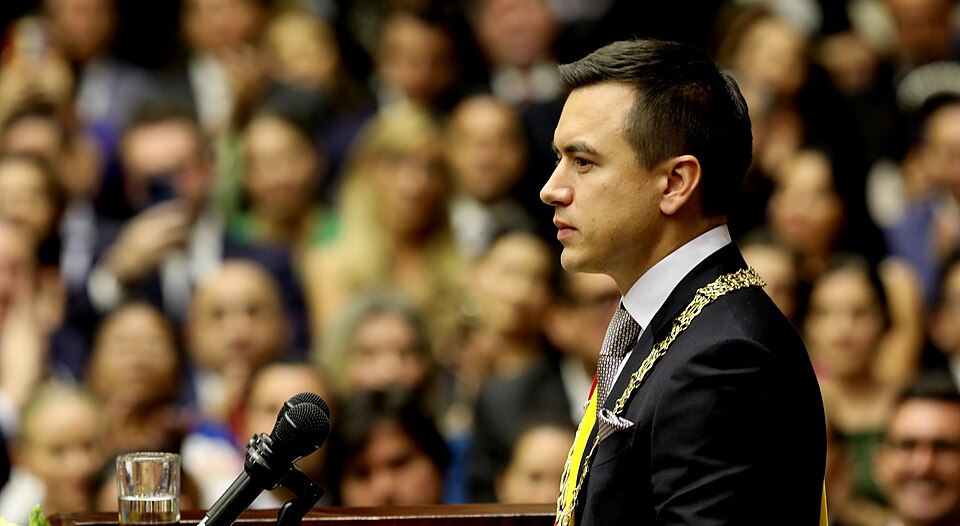
In November 2025, Ecuadorian voters overwhelmingly rejected President Daniel Noboa’s constitutional referendum, dealing his first major electoral defeat and halting his effort to initiate a constituent process to rewrite the 2008 Constitution. The vote unfolded against a backdrop of sustained tensions between the executive and the Constitutional Court, disputes over security governance, and fears of regression in fundamental rights. Andrés Martinez-Moscoso examines the political, institutional, and societal dynamics that shaped the referendum’s failure and assesses its implications for Ecuador’s constitutional order and future reform pathways.
In Latin America, since the emergence of neo-constitutionalism, it has become common to use democratic mechanisms—such as referendums—to ensure citizen participation in decision-making, but also as instruments for measuring political popularity.
In Ecuador, this tradition persists. In 2025 alone, citizens have gone to the polls three times: for the presidential election in February, the runoff in April, and earlier this month for a constitutional referendum in which nearly 14 million Ecuadorians voted on the following four questions:
- Whether to lift the ban on foreign military bases on Ecuadorian territory;
- Whether to eliminate state financing for political parties;
- Whether to reduce the number of members in the National Assembly; and
- Whether to establish a Constituent Assembly to rewrite the Constitution.
Voters received a single ballot containing the four questions, involving three different constitutional reform procedures: the partial reform procedure under Article 442 of the Constitution for the vote on the establishment of foreign military bases, the constitutional amendment procedure under Article 443 of the Constitution for the two votes on the changes to legislative representation and the elimination of public financing for political parties, and the procedure to initiate a constituent process to draft a new constitution under Article 444 of the Constitution.
President Daniel Noboa won every election he participated in since 2023, including previous referendums. With more than 60% of voters rejecting the proposals, the outcome of this referendum therefore represents his first electoral defeat. This can be interpreted from several perspectives. First, as a vote of public disapproval in his administration. Second, as a societal rejection stemming from fear that a new Constitution would roll back on the catalogue of human rights enshrined in the 2008 Constitution. And third, even though Noboa still enjoys more than 50% of support, as a refusal from citizens to give him a blank check due to lack of clarity in the model of the new constitution proposed by the government. While leaving the details of the proposal to be disclosed after the referendum, Noboa indicated the proposed Constitution would be much shorter, with a maximum of 180 articles.
A Constitutional Reform Agenda
Since assuming office, Noboa’s agenda has focused on promoting constitutional changes as he considers that the current Constitution is too restrictive of executive actions in matters of security, economy, and governance.
In an earlier piece, I referred to Ecuador’s high levels of insecurity and to the 2024 proposed constitutional reform to allow the Armed Forces to collaborate with the National Police in citizen security tasks. Although this proposal initially enjoyed broad public support, security conditions have not improved. Since the government’s declaration of an “internal armed conflict” in 2024 and the continued use of states of emergency, tensions between the government and the Constitutional Court emerged. On several occasions, the Court admonished the President, reminding him that crimes must be confronted through ordinary legislation and within the limits imposed by the rule of law, impairing Noboa’s ability to push his constitutional reform agenda forward.
During the last legislative period, the President enacted a package of reforms related to the fight against organized crime and corruption. However, his party in the National Congress violated procedural rules, leading the Constitutional Court to declare these reforms unconstitutional, triggering political unrest, public demonstrations, threats of impeachment against constitutional judges, and ultimately the push for a constituent process.
When it comes to the debate over drafting a new constitution, while the government argues—based on the classical theory that sovereignty resides in the people—that the electorate may enact a new constitutional text without being subject to any limits from the judiciary, the Constitutional Court held that a constituent process may be initiated only if: (i) it does not entail the creation of an assembly vested with full powers; (ii) it ensures recognition of human dignity as the foundation of the legal system, respect for international human rights instruments, and adherence to peremptory norms of jus cogens; and (iii) once approved, the new constitutional text may be subject to review by the Constitutional Court.
These two contrasting positions cement pre-existing tensions between the government and the Constitutional Court. In fact, the current composition of judges on the Constitutional Court has experienced significant friction with the President, particularly regarding the constitutional oversight the Court exercises. These tensions have become evident due to three key factors: (1) the Court’s declaration of unconstitutionality of several presidential decrees related to states of exception based on national security grounds; (2) its invalidation of laws that, in Noboa’s view, were essential for combating corruption and organized crime; and (3) its role as the guardian of the spirit of the Constitution, establishing criteria and red lines that could not be crossed in a potential constituent process.
President Noboa decided to call the referendum at that specific moment as a direct response to his ongoing conflict with the [Constitutional] Court, which had repeatedly limited the states of exception he issued and struck down several laws he considered strategic.
In this context, the current referendum seems to represent Noboa’s political reaction against the Constitutional Court and attempt to put back the constitutional reform question on the agenda. President Noboa decided to call the referendum at that specific moment as a direct response to his ongoing conflict with the Court, which had repeatedly limited the states of exception he issued and struck down several laws he considered strategic.
Confronted with these institutional constraints, the referendum became a mechanism for him to regain political initiative and to reshape the constitutional framework on his own terms. Although the referendum contained four questions, only the questions related to the lifting of the ban on foreign military bases and the establishment of a constituent assembly addressed core constitutional issues. The other two—focused on political parties and the reduction of public financing for political activities—functioned largely as “hook” questions, designed to broaden electoral appeal and encourage voters to approve the entire package.
United for NO: Why did the Referendum Fail?
The election on 16 November unfolded peacefully, but polls were once again inaccurate. While one week before the vote, surveys predicted the government’s victory on all four questions, more than 60% of voters rejected the proposals. The question concerning the installation of foreign military bases faced particularly strong opposition. This negative reaction intensified after government officials initially suggested that one of the potential bases could be located in the Galápagos Islands, a UNESCO World Heritage Site. The prospect resonated poorly with the public, especially given the historical precedent of military installations on the islands during the Second World War.
Although this defeat can partly be attributed to an ineffective political campaign, other factors were at play. The campaign period was short, and only a few political parties formally registered to oppose the government’s initiative. Those that did participate campaigned weakly, and in some cases even opportunistically, as they hoped that a constituent assembly might later offer political concessions.
Rather than confronting a single organized opponent, the government faced a broad and heterogeneous coalition of civil-society actors who successfully articulated the risks associated with the referendum.
At the same time, the government relied heavily on President Noboa’s personal popularity and assumed that most of the questions were “politically safe,” making an intensive campaign, in their view, almost unnecessary. This miscalculation overlooked the complexity of the vote: although mobilizing support for a “No” was difficult on most issues, the proposal to initiate a new constituent process was particularly controversial. The government expected that the President’s personal involvement would be sufficient to mobilize the electorate, yet this strategy proved ineffective. Rather than confronting a single organized opponent, the government faced a broad and heterogeneous coalition of civil-society actors who successfully articulated the risks associated with the referendum.
Academic voices also played a significant role in the outcome of the vote. Scholars publicly argued against the President’s proposal on two main grounds: first, that while the Constitution is not perfect, necessary adjustments could be made through ordinary constitutional reform mechanisms, as clarified by the Constitutional Court, and second, that convening a constituent assembly would pose serious risks of regression in fundamental rights. In fact, in the months leading up to the referendum, the government and several pro-government public figures and political commentators openly criticized the 2008 Constitution, particularly its recognition of Nature as a subject of rights, emphasizing that no other constitution in the world contains such a provision. They also argued that the Constitution’s strong environmental protections were an obstacle to economic and productive development, leading many to fear that a new Constitution would weaken or entirely remove these guarantees
Civil society organizations, unions, and professional associations also mobilized. These groups, already engaged in various disputes with the Noboa administration, accused the President of authoritarian tendencies and of weakening public services and social protections.
Additionally, events from the weeks preceding the vote had an impact: the strong resistance led by Indigenous peoples in the northern highlands after the government announced the removal of diesel subsidies escalated into episodes of police violence that were poorly received by the public. This affected the President’s popularity and reinforced perceptions of authoritarian behavior.
In this context, no opposition party can legitimately claim victory following the referendum results. A more accurate interpretation of the outcome of the vote is that it reflects a citizen-driven response—a collective defense of the rights enshrined in the Constitution and a refusal to endorse a transformative constitutional project that lacks clarity.
Is there always light at the end of the tunnel?
Daniel Noboa acknowledged the results on the night of 16 November. In his brief remarks, he outlined the constitutional path ahead, stating:
“Here are the results. We asked Ecuadorians, and they have spoken. We fulfilled our promise to consult them directly. We respect the will of the Ecuadorian people. Our commitment does not change; it becomes stronger. We will continue fighting tirelessly for the country you deserve, using the tools we have.”
In doing so, he accepted that he would govern for the remainder of his term—almost four years—under the current constitutional framework.
Soon after, he carried out a cabinet reshuffle. One appointment drew particular attention: the incorporation of former constitutional court judge Enrique Herrería as Chief Legal Counsel to the President. This move can be interpreted in two contrasting ways.
One optimistic reading is that the President is surrounding himself with constitutional experts who can help steer his administration within the boundaries of the rule of law. A more realpolitik interpretation is that he could be seeking the expertise of constitutional lawyers who know how to dismantle judicial oversight or push structural changes through the National Congress—where he holds a majority—for example by amending the “Law on Constitutional Guarantees and Constitutional Review,” which regulates constitutional jurisdiction.
(...) Ecuadorian policymakers must build bridges between the government and the people that foster governability, while lawyers and academics must continue disseminating the Court’s jurisprudence to strengthen institutionalism and due process (...).
Over the past five years, the Constitutional Court has clarified, through its jurisprudence, which mechanisms can be used to reform critical institutional features of the Constitution. If the President and other political actors choose to follow institutional procedures rather than impose their political agenda, these could form the basis for future amendments or partial reforms. To do so Ecuadorian policymakers must build bridges between the government and the people that foster governability, while lawyers and academics must continue disseminating the Court’s jurisprudence to strengthen institutionalism and due process, preventing the country from sliding into authoritarian tendencies in its constitutional reform efforts.
What’s Next?
Taken together, the last presidential elections and the recent constitutional referendum reveal a polarized country which, despite having renewed Daniel Noboa’s mandate, issued a clear warning: citizens do not wish to see setbacks in their constitutional framework.
In the coming months, no significant shift in the President’s agenda is expected, particularly given his insistence on implementing new international cooperation measures on security and on reducing public spending—policies that could negatively affect economic, social, cultural, and environmental rights, as well as potentially lead to increased labor-market flexibilization.
At the constitutional level, the results of the referendum reaffirm the legitimacy of the 2008 Constitution and its substantive content. The rejection of a new constitutional project strengthens the social pact that binds Ecuadorians. This outcome, however, should not be interpreted as indicating that the constitutional text does not require modifications; rather, it suggests that any future changes should be undertaken through the established constitutional amendment and partial reform procedures, rather than the setting up of a constituent assembly.
Andrés Martínez-Moscoso is a professor of Constitutional Law at Universidad San Francisco de Quito, Ecuador. He holds a PhD in Constitutional Law from Alicante University, Spain. He is a member of the Ecuadorian chapter of the Ibero-American Institute of Constitutional Law and Secretary at the Ecuador Chapter of the International Society of Public Law (ICON•S).
♦ ♦ ♦
Suggested citation: Andrés Martínez-Moscoso, ‘The People’s Verdict: Why did Ecuador’s Constitutional Referendum Fail?’, ConstitutionNet, International IDEA, 2 December 2025, https://constitutionnet.org/news/voices/peoples-verdict-why-did-ecuadors-constitutional-referendum-fail
Click here for updates on constitutional developments in Ecuador.
If you are interested in contributing a Voices from the Field piece on constitutional change in your country, please contact us at constitutionnet@idea.int.