

Bangladesh’s Referendum and Reforms: The Need to Return to a Constitutional Process

On 12 February 2026, voters in Bangladesh cast ballots in concurrent parliamentary elections and a constitutional referendum held under the Interim Government. While the Bangladesh Nationalist Party secured a two-thirds supermajority and 68% of voters endorsed the reform package, the referendum’s ambiguously framed questions left unclear which of the July Charter’s proposals were actually approved and what binding force they carry. This article examines how the path from negotiated Charter to popular vote has generated confusion over mandate, legitimacy, and the proper limits of interim governance in Bangladesh’s fragile constitutional transition.
On 12 February 2026, voters in Bangladesh cast their ballots concurrently in the 13th parliamentary elections and a constitutional referendum, both held under the Interim Government of Bangladesh (IG), led by Nobel Laureate Prof. Mohammad Yunus. The Bangladesh National Party (BNP) secured a decisive two-third supermajority, returning to power for the first time in 17 years. The elections saw a voter turnout of approximately 60%, with a majority of voters (68%) also endorsing the constitutional referendum.
The IG took oaths of office on 8 August 2024, following the collapse of the Awami League government after its brutal repression of protestors in the July Uprising, and the unprecedented killings of more than 800 people—possibly as many as 1400—including students, workers and children. During its tenure, the IG took some steps to address issues of justice and accountability for these atrocities and to begin a transition to elections, alongside efforts to develop proposals for constitutional, legal and institutional reforms. The referendum marks the culmination of the IG’s reform efforts.
Following the establishment of eleven reform commissions in October 2024, which involved varying levels of public participation and consultation, the IG ultimately established a National Consensus Commission (NCC) in February 2025 to steer political negotiations and consolidate the reform agenda. The NCC comprised eight representatives (all men) drawn from only six of the eleven reform commissions, with four reform commission, notably the women’s commission, excluded from its composition and terms of reference.
Out of the 37 parties consulted, 33 provided feedback, 32 met during a first round of consultations between 20 March and 19 May 2025, and 30 met during a second round between 3 June and 31 July 2025. The outcome of these negotiations, the July Charter of 2025, was signed by 33 parties on 17 November 2025. The final document includes ‘noted reservations’ by ‘some parties’ on ‘certain points.’ A detailed analysis of the content of the Charter is available here.
The declaration of the Charter was made by the participating ‘political parties and alliances’, rather than by the members of the NCC (with the Awami League excluded, having been banned under the controversial Anti-Terrorism Act). The signatories agreed that these reflected a collective reform agenda, subject to detailed notes of dissent that were not spelled out in the text. However, they did not specify the next steps in the process, including any mechanism for clarification or implementation.
From Charter to Referendum: Confusions and Elisions
Following the signing of the Charter, the July National Charter (Constitutional Amendment) Implementation Order 2025 was promulgated as a Presidential Order on 13 November 2025, authorising the Election Commission to hold a referendum with respect to certain provisions of the Charter and governance-related reforms to the Constitution. It also stated for the first time that, in the event of an affirmative vote, the newly elected Members of Parliament would serve as a Constitution Reform Assembly to adopt amendments to the Constitution within 180 days, and upon election would take an oath both as Members of Parliament and as Members of this Assembly.
The ballot paper for the referendum asked voters four questions, as determined by the IG and set out in section 4 of the Order. Voters could not respond to each question separately and were instead required to answer all four together. The questions asked voters whether to:
- Constitute a caretaker government, an Election Commission and constitutional institutions in accordance with the July Charter proposals;
- Set up an Upper House of 100 members, elected based on proportional representation of the parties taking part in the elections, and requiring majority approval of these members for any constitutional amendment;
- Adopt 30 constitutional reforms (based on the consensus of political parties in the Charter), including related to increased representation of women, election of opposition members as Deputy Speaker and Chairs of Standing Committees, term limits for the Prime Minister, expansion of fundamental rights, judicial independence, and strengthening of local government; and
- Implement other reforms according to commitments made by political parties.
These questions appear to reflect at least 20 out of the 47 proposals contained in the Charter, but it is unclear what the electorate voted for with respect to the remainder. Questions 1 and 2 are relatively clear. Question 1 covers reforms related to the caretaker government and Election Commission, as well as constitutional institutions—presumably including the President, Prime Minister, Ombudsman, Public Service Commission, Comptroller and Auditor General—covering five of the 47 reform proposals. Question 2 focuses on the proposed Upper House, accounting for an additional four proposals.
Confusion however arises with regard to question 3 referring to 30 reform proposals on which there is political party consensus, but naming only eight of these (points 21, 23, 24, 14, 13, 33, and 44-47 respectively). In combination with questions 1 and 2, these cover a total of 19 of the 47 proposals. It is therefore unclear which of the remaining 28 proposals were endorsed by those voting ‘yes’. It is particularly remarkable as only six of the Charter proposals recorded no dissent by political parties.
This lack of clarity might lead to a conflict between the parties represented in the newly formed Parliament over which of the proposals they are compelled to implement (...).
As noted by one commentator, “voters cannot know with certainty which 30 out of 37 reforms a “yes” vote is formally endorsing as constitutional obligations, and which remain matters of future political discretion.” This lack of clarity might lead to a conflict between the parties represented in the newly formed Parliament over which of the proposals they are compelled to implement, and which can be subject to further debate and discussion. Of course, this also begs the question of whether this referendum creates any kind of binding obligation on elected representatives and the Government.
A Controversial Referendum Process
The referendum involved 127.7 million registered voters, with a reported turnout of 60%. While voters in the parliamentary elections could identify parties through their symbols, rather than relying solely on text, the referendum required voters to read all four questions and then cast a ‘yes’ or ‘no’ vote. Even for literate voters, understanding the content of each question was extremely challenging for the reasons described above, raising serious questions regarding the nature of the mandate conferred, particularly by those lacking functional literacy.
The IG invested in a massive media campaign in support of the referendum, allocating over 1.4 billion taka despite questions over the legitimacy of this role and a belated clarification from the Election Commission of Bangladesh that government officials could not urge citizens to support either side. These efforts included highly produced videos broadcast in public spaces, such as parks and airports, posters and festoons displayed in government buildings, and extensive social media campaigns. However, the messages were selective and, in some cases, reduced to statements such as that repeated by one IG Advisor that only those ‘in favour of fascism’ would vote against the referendum.
[The Interim Government] provided no clarity regarding how the referendum questions relate to the July Charter commitments, or the extent of the ‘political consensus’ on which it was based.
However, the IG provided no clarity regarding how the referendum questions relate to the July Charter commitments, or the extent of the ‘political consensus’ on which it was based. Some of the “information” videos broadcast by the IG showed people dancing or singing, dressed in the national colours of red and green, against shifting backgrounds of hills and rivers and national monuments, with simplistic chants (for instance, “vote yes for change, and get the keys to the nation” (poribortoner jonno ‘hya’ don, desher chabi bujhi lon’), with no content elaborating on the actual political commitments being made.
Several commentators questioned the role of the IG in campaigning in favour of the referendum, raising concerns about its adoption of a partisan role and the need to distinguish its functions from those of an elected political government. The IG itself sought to robustly justify its role, responding to some critics, and in other cases, highly regrettably engaging in ad hominem attacks, recalling the practices of the previous authoritarian regime.
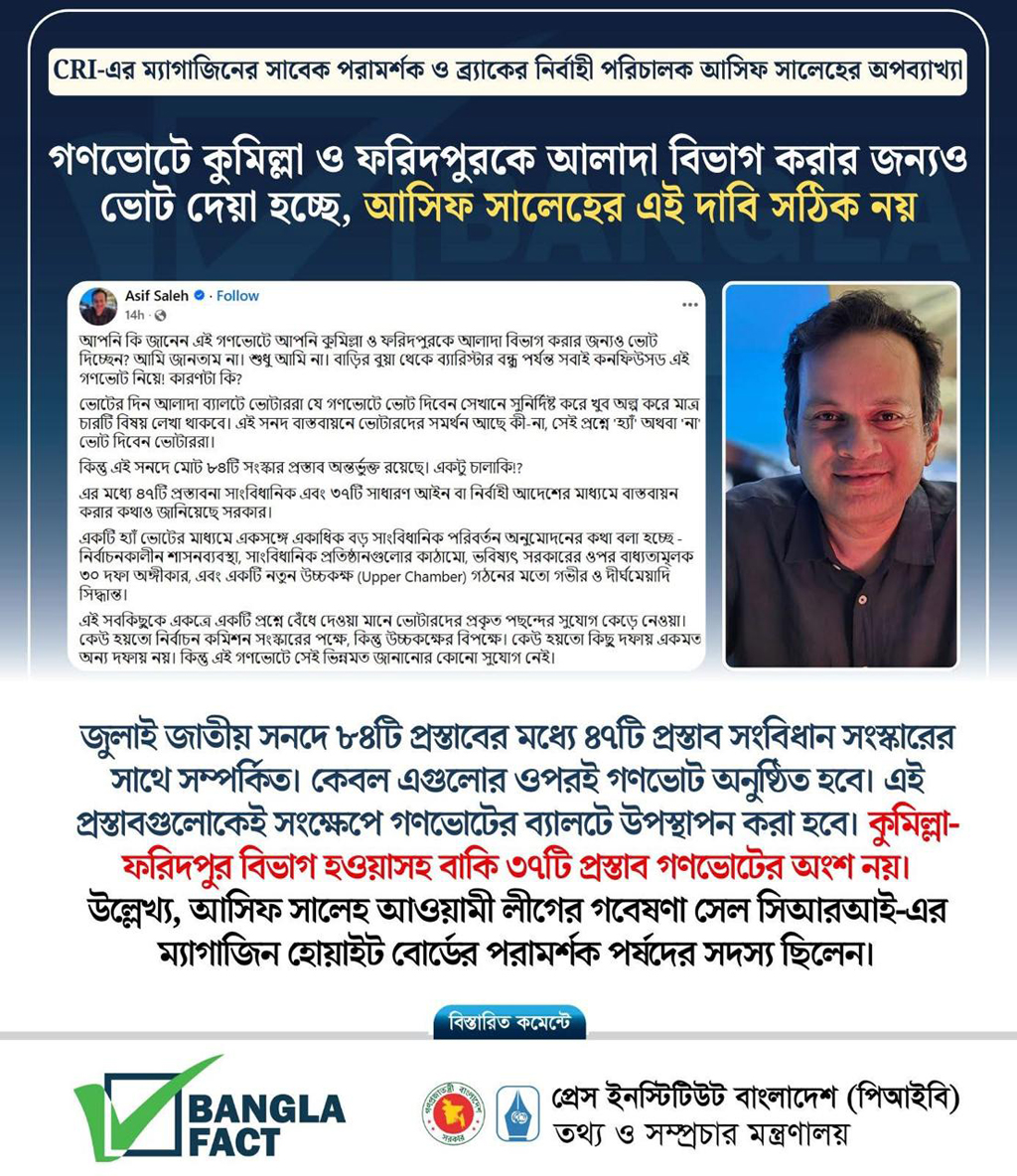
Other commentators have raised concerns regarding the referendum process, highlighting the limits of the role of an interim administration: “When an interim government confines itself to explaining the process, ensuring access to information, protecting dissent, and safeguarding the vote, it demonstrates respect for that popular mandate. However, when it campaigns actively for a particular outcome, it risks substituting its own judgement for the people's and narrowing the space for genuine democratic choice.”
Missed Opportunity?
The conflicting approaches among the key political contenders regarding the referendum and several of the Charter proposals have been reflected even before the formation of the Government. In fact, the BNP and some independent parties refused to take the second oath described in the President’s Order, pointing to the lack of constitutional legitimacy, while the Jamaat and NCP parties, which initially refused to take the constitutional oath, did so later in the day.
In the meantime, a writ has been filed with the High Court challenging the constitutional validity of the referendum and seeking annulment of its results. Among other things, the petition refers to the lack of constitutional framework around the referendum, as well as the lack of voter education, question clarity, informed consent, and judicial oversight. Constitutional lawyers are raising arguments in the media both in favour of the referendum—as representing the ‘people’s verdict’, notwithstanding the lack of information available to, or even participation by, the people—and against it, and may soon do so in court.
What is more, the referendum omitted many critical questions facing the country following the Uprising, as did the July Charter. Neither addressed the issue of justice for crimes against humanity, and gross violations of human rights—the very issues that catalysed the Uprising and enabled political change–nor the question of transitional justice, including how to ensure that processes to seek truth, justice, and accountability are accompanied by reconciliation. They did not address reforms aimed at ending discrimination, despite this being the rallying cry of protestors during the Uprising.
These issues need to come back to the centre of political debate and discourse and demand the urgent attention of all relevant actors—the Executive, Legislature and the Judiciary—if Bangladesh is to move forward. Parliamentary debates, reflected and refracted in public discussions offer a path to hammer out practical and workable reforms, and to do so through a process that is constitutional and more likely to withstand the test of history.
About the Author
Sara Hossain is a Senior Advocate at the Supreme Court of Bangladesh.
Suggested Citation
Sara Hossain, ‘Bangladesh’s Referendum and Reforms: The Need to Return to a Constitutional Process’, ConstitutionNet, International IDEA, 2 March 2026, https://constitutionnet.org/news/voices/bangladeshs-referendum-and-reforms-need-return-constitutional-process
Further Reading
- Updates on constitutional developments in Bangladesh.
- Muhammad Ekramul Haque and Sumit Bisarya, July Charter and Constitutional Reforms in Bangladesh (2025).
- International IDEA, Primer on Direct Democracy.
Contribute to Voices from the Field
If you are interested in contributing a Voices from the Field piece on constitutional change in your country, please contact us at constitutionnet@idea.int.